2010-11-20

Gatehouse map with symbols and numbers

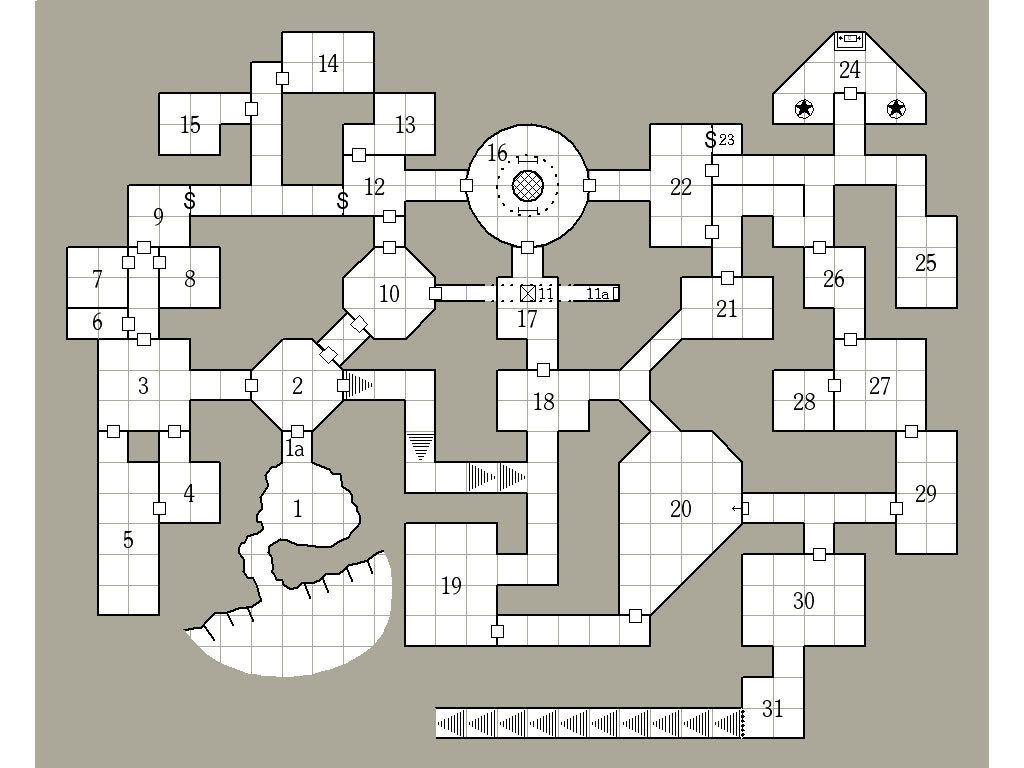
The gatehouse map is done.  I made a Moldvay-style symbol catalog - it turns out that it's pretty easy to do.  I had to redo half the symbols because I didn't test the first door I created, because there are some bugs in how the symbol control points work.  Chances are you have no idea what that means, but my solution was to just not use symbol control points.  So I spent a few hours reworking some symbols, and popped them into the map.

The other two bugs I noticed were:

a. When printing to the printer, the doors are solid black, instead of white outlined with black.  Maybe CC3 fixes this, or maybe it's my printer driver.
b. When saving as a JPG, some of the diagonal lines turn a little "jagged", you can see a few spots like that near the octagonal rooms.

So here's the completed map, click to make it larger.  It definitely looks computer-generated, I don't know how I'd make it look more hand-sketched.  So a little sterile, but way more useful for a PDF than a scan of the hand-drawn original.

2010-11-18

More about last night's session

Last night's session was a lot of fun, despite the horrible deaths visited on the party.  A wandering monster roll went horribly wrong, and 6 zombies surprised the party.  If they had run away immediately, they would've been fine, but the party is a bloodthirsty bunch.  If they see it, they want to kill it.  They almost launched themselves at the fire beetles in a fury.  Wandering monsters have no cash, so eventually they'll pick up on the risk/reward equation here.

At least one player has started giving advice on how old-school dungeons are laid out, so they're picking up on what's going on.

The maps continue to have epic-level badness.  One of the two mappers said to the other, "How are you fitting this all on one page?"  "Oh, I shortened the long tunnels."  There is also a certain amount of misunderstanding of where one level begins and another ends.  They think they've gone deep, and are spanning multiple pieces of paper.  Their mapping misfortunes bring me no end of delight.

I'm not really into injecting realism when it's inconvenient for the game as a whole, so when one player couldn't make it and another who wasn't around last time showed up, I just had them pop up in the middle of the dungeon.  The gatehouse level isn't much of a challenge to navigate anymore, so I just did some hand-waving and the absent PC left, present PC waltzed in.  I did kill off 75% of the party with wandering monsters and a panicky run into the dark, so I'm not worried that I'm being too lenient.  I didn't do a reaction roll for the blade zombies, though, so that was a little harsh.  I'll have to come up with a reason for wandering blade zombies, and the skeletons, too.  Probably I'll have a bunch of insane necromancers living on the second level, cranking out zombies and sending them forth to the upper levels to slay the living.

The "survival horror" theme I deliberately injected into the first level is working out great.  Of course, at first level, it's not hard to achieve that feeling.  Now I'm getting all psyched up to detail a bunch of evil clown encounters for the second level.  I also want to add some of the "Thundarr" flavor back into the game, so I'll start detailing the central city.  Gigantic lights on the mountain are now broadcasting the existence of the megadungeon, so city politics will start to intrude on the nearby villages, and rival adventuring parties will begin to throw themselves into the meat-grinder.  Only the party knows about the gatehouse entrance, so the rest of the world must contend with the horrors of the lower levels - if the party can keep their mouths shut, and continue to end sessions with most of their henchmen dead, they stand a good chance of keeping that entrance all to themselves.  Until somebody notices them coming out with truckloads of money.  Or they hire a caravan to carry all the ridiculously bulky loot out of the dungeon.

Tonight, I plan to do a bit more work on the symbols, so I expect I'll have the gatehouse map converted to an electronic format by tomorrow night.

The next session is 3 weeks off, rather than 2, so there's plenty of time to mess around with the city and villages.

Session recap, 11/17/2010

Here's the recap email I just sent for tonight's session:

Gentlemen,

Here's a recap of tonight's (tragic) session.

The party, having decided to spend the night in the dungeon, was disturbed by loud screams during the night.  At one point, the screams were right outside the spiked-shut door, but they fortunately moved on.

With their spells recovered, the party stepped outside the room, and were greeted by the sight of their dwarven comrade Rollo Jr. heading down the stairs.  Gutboy, his elven henchman, and his two dogs greeted Rollo Jr., and ran upstairs to head back to town.  After this tag-team maneuver, the party headed back towards the throne room they had discovered the day before.

The throne was pushed out of the way, and Rollo descended the ladder to see what lay below.  A rough-hewn stone corridor extended south as far as he could see, with torch brackets lining on the walls at 5' intervals.  The rest of the party climbed down the ladder, and they headed south, following the corridor to its end, where a set of stairs led up to an oaken door.

Opening the door, they found themselves in a large room, empty except for a black metal circle on the western wall, 10' wide.  Within the circle was a gigantic, slitted eye, with a black pupil and deep purple iris.  The eye watched the party as they entered the room.  Rollo used his 10' pole to poke the eye, with disastrous results.  He was filled with a deep hatred for all living things, and rushed at Too with his sword drawn.  Fortunately, he missed, and after a few minutes regained his senses.  The group decided not to further disturb the eye, and continued on through a tunnel on the far side of the room.

This tunnel led up another set of stairs, into a room empty of all but a thick layer of dust.  As P.W. listened at one of the doors exiting this room, a swarm of six large beetles, two and a half feet long, with glowing lights upon their heads and in their bellies, entered the room from the corridor they just came from.  The beetles were not hostile, and remained at the entrance to the room.  The group considered attacking them, but decided to leave the room through a door in the northeast wall, and closed it behind them so the beetles could not follow.

Heading southeast, they came to a door that opened into an alcove off a long 30' wide hall.  This hall stretch to the east and west as far as could be seen by the feeble torchlight, and was lined with 10' wide alcoves on the north and south sides.  Exploring these alcoves, the party found rotted furniture, small heaps of ash, jewels pasted to the walls, animated skeletons, and a sarcophagus containing a single animated skeleton and a jeweled spear under a false bottom.  The skeletons were quickly dispatched, and the loot taken.

The last alcove investigated had a door, with a humanoid skin nailed to it.  The skin was white, and covered with patches of gray fur or hair.  Behind this door was an empty room, with an equally empty closet.

The party kept moving eastward down the corridor, stopping to briefly examine an archway in the southern wall, with a smiling, bearded face sculpted into the arch at its apex.  They ignored this opening, and continued hundreds of feet onwards as the corridor turned north.  As it turned, they found three doors on the south wall.  Stopping to measure and make sure the map was correct, the party was surprised by six corpses emerging from the gloom.  The walking dead had knives pushed through the backs of their heads, with the blades emerging from their eyes.

The horrid creatures began carving through the party.  First Rollo, then the Claw, and the henchmen Zarak and Dingo were killed, the creatures attacking with swords and head-butting with the blades protruding from their skulls.  P.W.'s attempt to douse the fiends with holy water failed when he accidentally spilled it all over the ground.  Overwhelmed, Too, P.W., and the henchman Fast Eddie ran heedlessly down the corridor, frantically looking for the door to the north they had used to enter this passageway.  They accidentally ran past the alcove, but saw a door in an alcove to the south.  Running through this door, they slammed it shut and ran down a southern passageway, bursting through a door at its southern end.

A horrible sight faced them:  a hideous creatures, with an egg-shaped gray body, eight spindly legs, and a 5' long prehensile neck that ended in a strangely goblin-like head, with massive jaws and giant black eyes.  The creature extended its neck and bit Too's head off.  As it began to consume the rest of Too's body, P.W. and Fast Eddie ran for their lives back north, and out into the 30' wide corridor.

The undead were nowhere in sight, so P.W. began checking the alcoves to see which one had a door leading north.  He quickly found it, and the duo made their way back to the surface.  They made their way back to town, and Fast Eddie proclaimed his loyalty to P.W., deciding their narrow escape must be due to P.W.'s good luck.

2010-11-16

Gatehouse map in CC2 (no doors)

I've completed the gatehouse map in CC2, but haven't added the doors yet (I'm not happy with the default set of symbols DD2 provided, so I'm going to make my own over the next few nights).

It turned out to be very very easy to draw the dungeon.  BUT, it is very very painful to draw that gray background.  It's a very convoluted process that involves copying and "exploding" and splitting elements to come up with the reversed-polygons.  I'm not looking forward to doing it on the first level map.

So here's the map done up in CC2.  Click to see a larger version.  The graph paper lines got distorted when Photobucket resized the image, it all looks very nice on my computer, and should look perfect in the PDF as well.


And here's the original pencil drawing on graph paper:

2010-11-15

Funhouse-style room

I'm not entirely sure I like the symbols in the Dungeon Designer 2 catalog.  They don't seem old-school enough.  I'm probably going to create new symbols - but this will of course slow my dungeon mapping down.  I'll give them a try on the gatehouse level and post the results, maybe they'll grow on me.

Below is a funhouse-style room (well, not an actual funhouse, that will be on Level 2).  You should be able to tell why I say my dungeon keys are much much much longer than most megadungeon examples.  I've still got that last room to detail, which is driving me nuts.  It's room 160 on the map.  I decided to put a bunch of tattered banners in room 159, which leads into 160 (if you don't take the side doors), but I can't figure out what kind of trap to actually put in room 160.  The most coherent thoughts I've had so far is "trap with monster."

Enough complaining, here's one of my "specials":

150. Misty Arches
The walls of this room are lined with archways, leading into small 10’ by 10’ rooms.  Each archway is filled with a thick mist of a different color (red, orange, yellow, white, black, green, blue, and purple), blocking vision into the room beyond.  In the center of the room is a stone pedestal, with a bronze jug standing upon it.  The jug has the image of a monkey-headed winged serpent carved into it.  The jug is full of fresh water.

Characters attempting to walk through the mists will find that only one player can be present in the room beyond at a time; other characters will be stopped as if the mist was made of solid stone.  Should two characters attempt to enter simultaneously, roll randomly to see which character makes it through the mist.

Each room has a painted scene on the walls, floor, and ceiling, and large stone basin sticking out of the far wall, with a drain hole in the bottom.  Whatever plumbing connects to the drain hole, it must be running through the wall, as the drain hole does not exit on the underside of the basin.  Should a character pour water from the bronze jug into the basin, a magical effect will be triggered.  The mist colors, painted scenes, and magical effects are detailed below.

Once an effect has occurred, it will not be available for another year’s time.  Pouring anything less than a full jug of water will have no effect, nor will pouring water from a container other than the jug.

a. Red Mist: the mural here is of flames and burning coals.  Pouring the water down the basin will cause a small glowing ball of red-yellow firelight to fall onto the floor, next to the character.  If thrown, this ball will act as the fireball spell, doing 3d6 points of damage (and consuming itself in the process).  If not used within 24 hours, it will turn to a small ball of cold charcoal.

b. Orange Mist: the mural here is of a field of orange poppy flowers.  Pouring the water down the basin will cause the character to become intoxicated, and will have a -2 on all to hit rolls for the next 24 hours.

c. Yellow Mist: a scene depicting a costume ball, with the guests recoiling in horror from a figure dressed in rags, wearing a tattered white mask.  Pouring the water down the basin will cause the scene to animate, and the character will see a horrible crowned figure in yellow robes enter the room, before the walls fade entirely to whitewashed plaster.  Having seen the King in Yellow, the character permanently loses 1d3 points of wisdom.

d. White Mist: the room beyond is painted sky-blue, with fluffy clouds.  Pouring the water down the basin will cause the character to be able to fly, as per the magic-user spell, for the next 24 hours.

e. Black Mist: the walls, floor, and ceiling are painted black.  Pouring the water down the basin will cause the player’s pupils to expand, until they occupy the entire visible portion of the eyeball.  The character will now have wide-spectrum vision, such as dwarves and elves possess, for the next 24 hours.  If the character already has wide-spectrum vision, they are able to briefly see between space and time, and must save vs. magic or become comatose for the next 1d6 turns, as their mind cannot handle the sights revealed.

f. Green Mist: this room is painted in a jungle scene, with thick vegetation, and lianas and other vines painted on the ceiling overhead.  Pouring the water down the basin in this room will cause a monkey to leap out of the image overhead, and land on the character’s back.  The monkey has 4 hp, is AC 9, and will not let go of the character.  Any hits to it will split the damage between the character and the monkey.  It has no attacks.  The monkey will hoot and holler for the next 24 hours, making surprise impossible, and increasing the chance of wandering monster by 1.  After the 24 hour period expires, the monkey will fall to the floor, dead.

g. Blue Mist: the room is painted in an undersea scene, with fishes, octopuses, and coral reefs painted on the walls and ceiling.  Pouring the water down the basin in this room will cause the character to be able to breathe water for the next 24 hours.

h. Purple Mist: the room is painted with veins of purplish color, ranging from near-black to lavender.  Pouring the water down the basin will cause the veins to being to shift and move around the floor, walls, and ceiling of this room.  The tendrils will then reach up from the floor, and wrap themselves around the character.  The writhing bands of color will twist around him for the next 24 hours, giving him +2 to his armor class for the duration.
2010-11-14

Re-learning Campaign Cartographer 2

The afternoon was spent in playing 3rd edition D&D, in a campaign where I'm a mere player.  It's been going on for 9 years now, on a once-monthly basis.  The combat takes soooooo long to resolve.  My thief got hit with a poison needle trap, and I figured I was dead dead dead.  I had forgotten that 3rd edition traps do damage, rather than save-or-die.  13 hp damage.  It was kind of a letdown, no rush for the neutralize poison or anything like that - just write off some hit points.  So now I like to think that when I force the players in my campaign to save-or-die, I'm adding excitement to their lives.  Well, to their deaths.

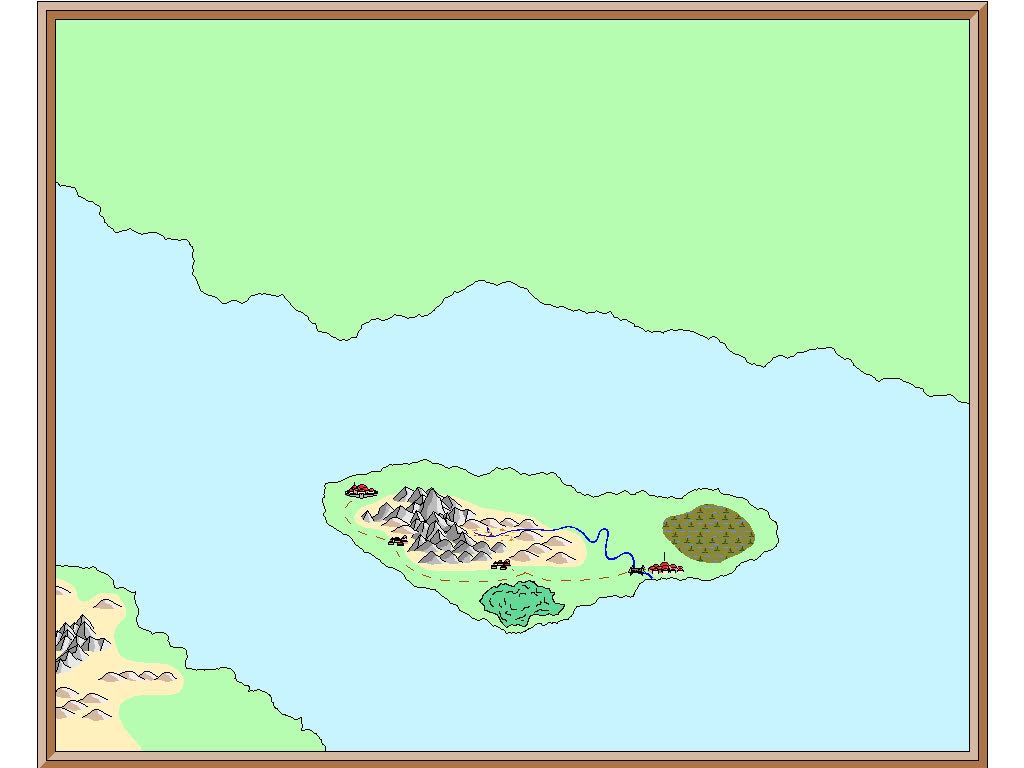
My few spare hours I had left after the day's festivities, I spent re-learning Campaign Cartographer 2.  I used to know how to do this, but that was ten years ago, so I've been doing the tutorial - about halfway through now.  I really only want to do dungeon maps, but I've got to learn the basics first, so I've been putting together a terrible little outdoor map as I follow the tutorial.  It's pretty easy getting the hang of it again though.  I'll take more care with the aesthetics once I'm doing the dungeon levels "for real".

ProFantasy has released Campaign Cartographer 3, but I don't know that I want to plunk down more than $100 to upgrade CC2 and the 2 expansions I got way-back-when (City Designer 2 and Dungeon Designer 2).  I don't really want any fancy coloring, just various shades of grays, and rooms with 10' square grid lines.

Anyhow, here's the fruits of my tutorial labor.  Click to get a larger view.

2010-11-11

Killing Players

It's possible that I am a "killer DM."  When I'm reading everybody else's session recaps, they speak endless of players being knocked unconscious, and getting revived later.  They also don't seem to encounter the endless series of traps that I've scattered around.

The first level of my megadungeon is loaded with traps.  It's also got lots of "specials" that are basically magical roulette wheels - the players don't know what's going to happen, they only know that something will, if they mess around with the obvious gimmicky thingamabob.  If they don't touch the gimmicky thingamabob, or walk away from the (rather obvious) traps, then life continues on.  The dungeon isn't actively out to get them, but if they want to try for the good stuff, they've got to figure these things out.

So that's tons of traps, often with save-or-die poison effects, and combat is brutal.  I'm trying to play Labyrinth Lord by the book, so you go to 0 hp, you're dead.  No funky tables that may save your life, no going to -10.  You're just dead.

All this makes players cautious, and they've gone a couple of sessions without losing a PC, so I don't think I've made anything too deadly.  I just find the contrast between how I'm running my campaign, and some of the session recaps of other people's campaigns, interesting.  Not good or bad, just different.  This is the first time I've been this much of a hardcase about the rules though.  It definitely adds some tension.

I've only got one room left to detail in the first level of the megadungeon, and then it's time to work on electronic versions of the maps.  I may have a PDF of the first level ready in December.  It's a lot (and I mean, a LOT) more verbose than other megadungeon material I've seen so far, for better or worse.  I personally prefer to have everything written out in detail beforehand.